
You Don’t Need More Content. You Need a Distribution Machine
Most founders think their social media problem is an idea problem.
It usually isn’t.
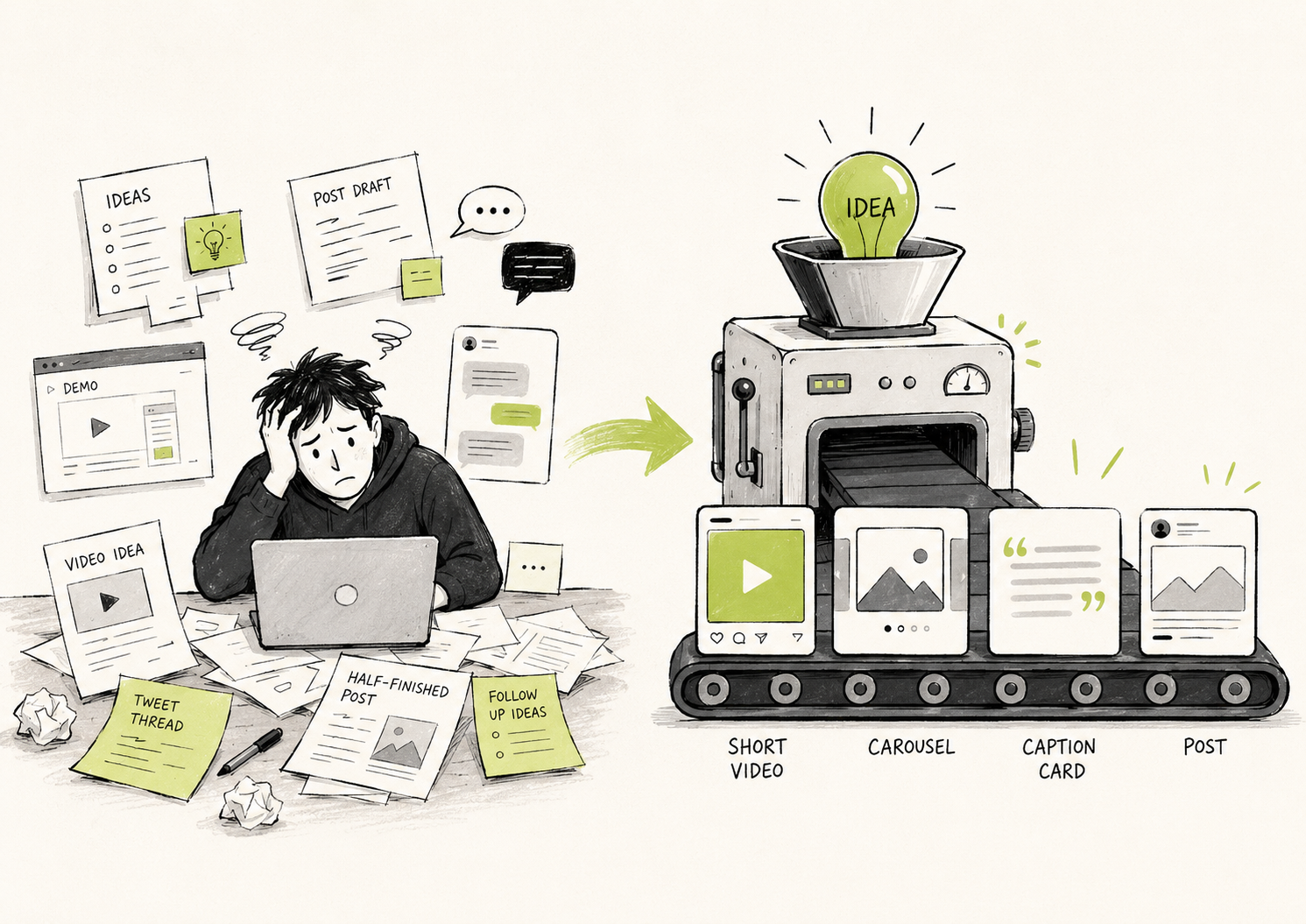
You already have product updates, founder takes, customer quotes, demo recordings, screenshots, messy notes, and half-written posts sitting somewhere in your workspace.
The real problem is what happens after the idea appears.
Someone has to turn it into a hook. Someone has to make the visual. Someone has to adapt it for each platform. Someone has to schedule it. Someone has to remember to publish it.
That is why small teams don’t lose because they are not creative enough. They lose because their distribution still runs on human hands.
The blank page is not the real bottleneck#
The blank page gets too much credit.
Yes, ideas matter. Bad ideas still make bad content. But for most small teams, the system does not break at the idea stage.
It breaks after the idea.
A founder records a quick product demo and never cuts it into clips.
A marketer writes one sharp post and never turns it into a carousel.
A team ships a feature, posts one announcement, and moves on.
A customer says something interesting on a call, but nobody turns it into content.
The raw material exists. It just never becomes distribution.
You don’t need one more brainstorming session.
You need a machine that can take one strong input and produce ten useful outputs.
One idea should not become one post#
A weak content workflow treats every post as a separate task.
One idea equals one post. One demo equals one upload. One launch equals one announcement. One customer quote equals one screenshot.
That is not a system. That is manual labor with better branding.
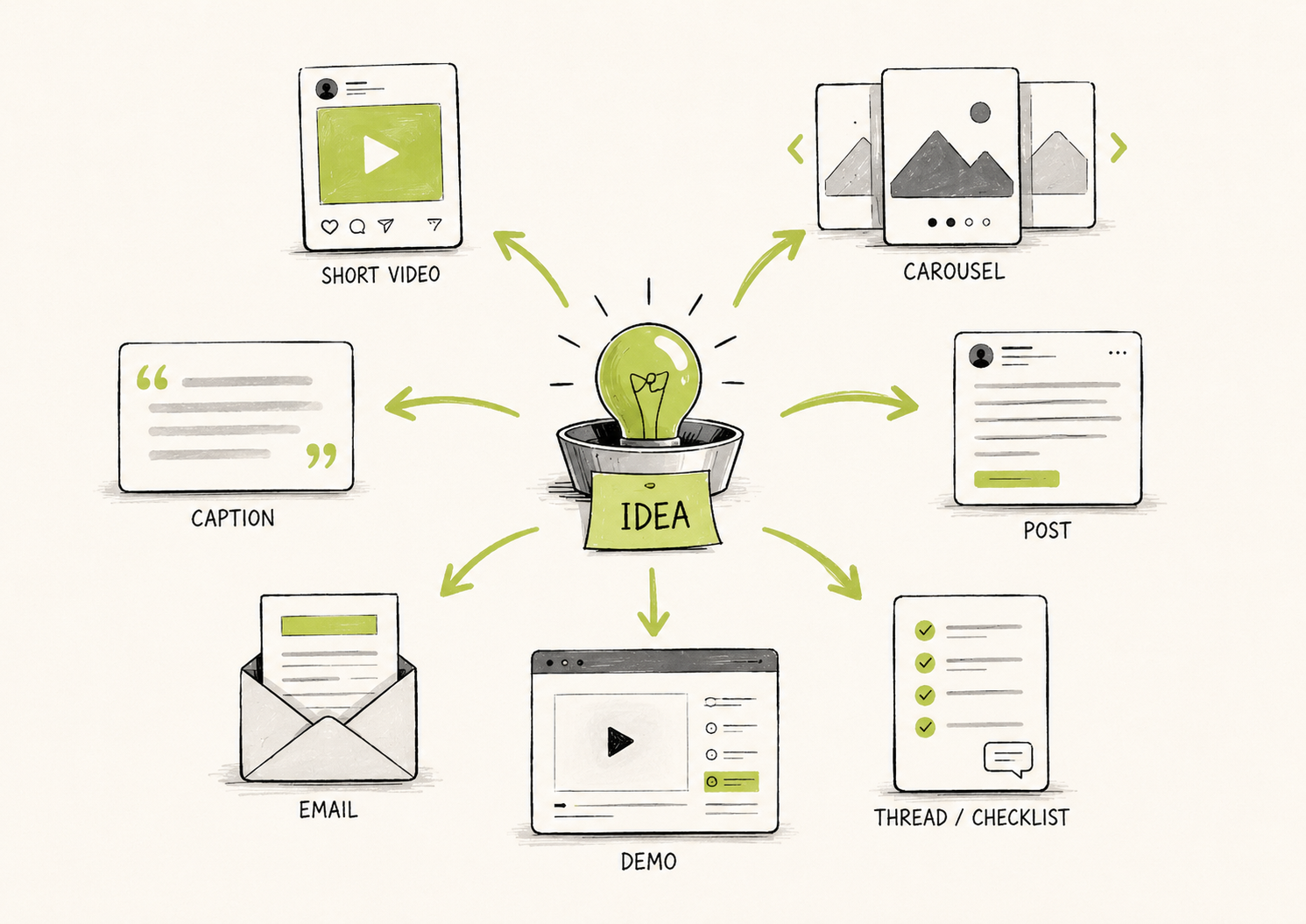
A strong content workflow treats every idea as source material.
One idea can become:
- a short-form video
- a carousel
- a founder post
- a meme-style caption
- a product demo
- a newsletter section
- a quote card
- a comparison post
- a “mistake we made” post
- a “what we learned” post
Same idea. Different angles. Different formats. Different platforms.
That is how small teams create the feeling of being everywhere without actually hiring a media department.
They don’t create more from scratch.
They repurpose better.
Clipping pages show the model in its simplest form#
Look at any successful clipping page.
The model is almost stupidly simple.
One creator makes long-form content. Someone else cuts the best moments. Those moments get posted as short clips again and again.
No new filming. No complex production. No original media empire.
Just long-form attention turned into short-form distribution.
And it works because clipping pages understand something most teams ignore:
The value is not only in creating the content. The value is in redistributing it properly.
A two-hour podcast might contain 20 short clips.
A 40-minute webinar might contain 10 strong hooks.
A founder interview might contain 15 posts, 5 carousels, 3 short videos, and a newsletter section.
Most teams publish the original asset once and call it done.
Distribution machines squeeze the asset until there is nothing useful left.
The real skill is finding the spike#
You can’t just chop content randomly and expect it to work.
The best short-form moments usually have a spike.
A spike can be:
- a strong opinion
- a painful truth
- a surprising result
- a relatable failure
- a sharp contrast
- a visible emotion
- a useful teardown
- a line people want to steal
This is why calm, informative content often underperforms.
It may be useful, but it does not always stop the scroll.
People don’t pause because something is “educational.” They pause because something creates tension.
That tension can be curiosity, disagreement, recognition, surprise, ambition, fear, or humor.
Good distribution is not just cutting content into smaller pieces. It is finding the moment that makes someone care.
AI can help generate options. AI can detect patterns. AI can suggest hooks. AI can format outputs.
But the operator still needs to know what feels alive.
Manual distribution breaks fast#
Now imagine running this manually.
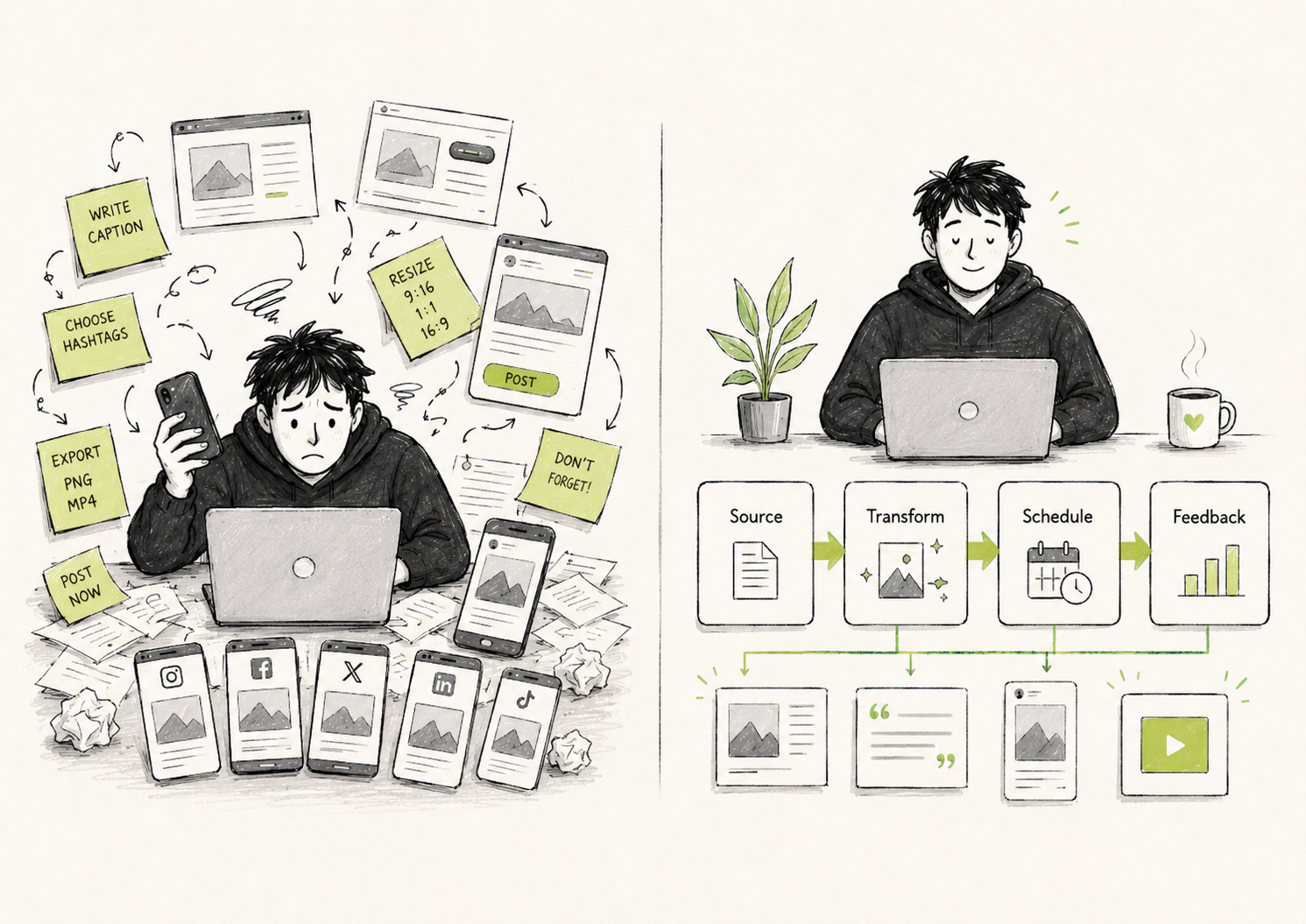
You take one long video. You watch it. You find moments. You cut clips. You add captions. You export. You write post copy. You adapt it for Instagram, TikTok, YouTube Shorts, X, and LinkedIn. You schedule everything.
Then you do it again tomorrow.
That workflow is fine for a week.
Then it becomes a job.
And once it becomes a job, consistency starts depending on your mood, calendar, energy, and discipline.
That is where most content systems die.
Not dramatically. They just slowly stop.
The founder gets busy. The marketer gets pulled into another task. The backlog gets messy. The posts become irregular. The team says, “we should really post more.” Nothing changes.
The problem was never motivation.
The problem was that the system was too manual to survive.
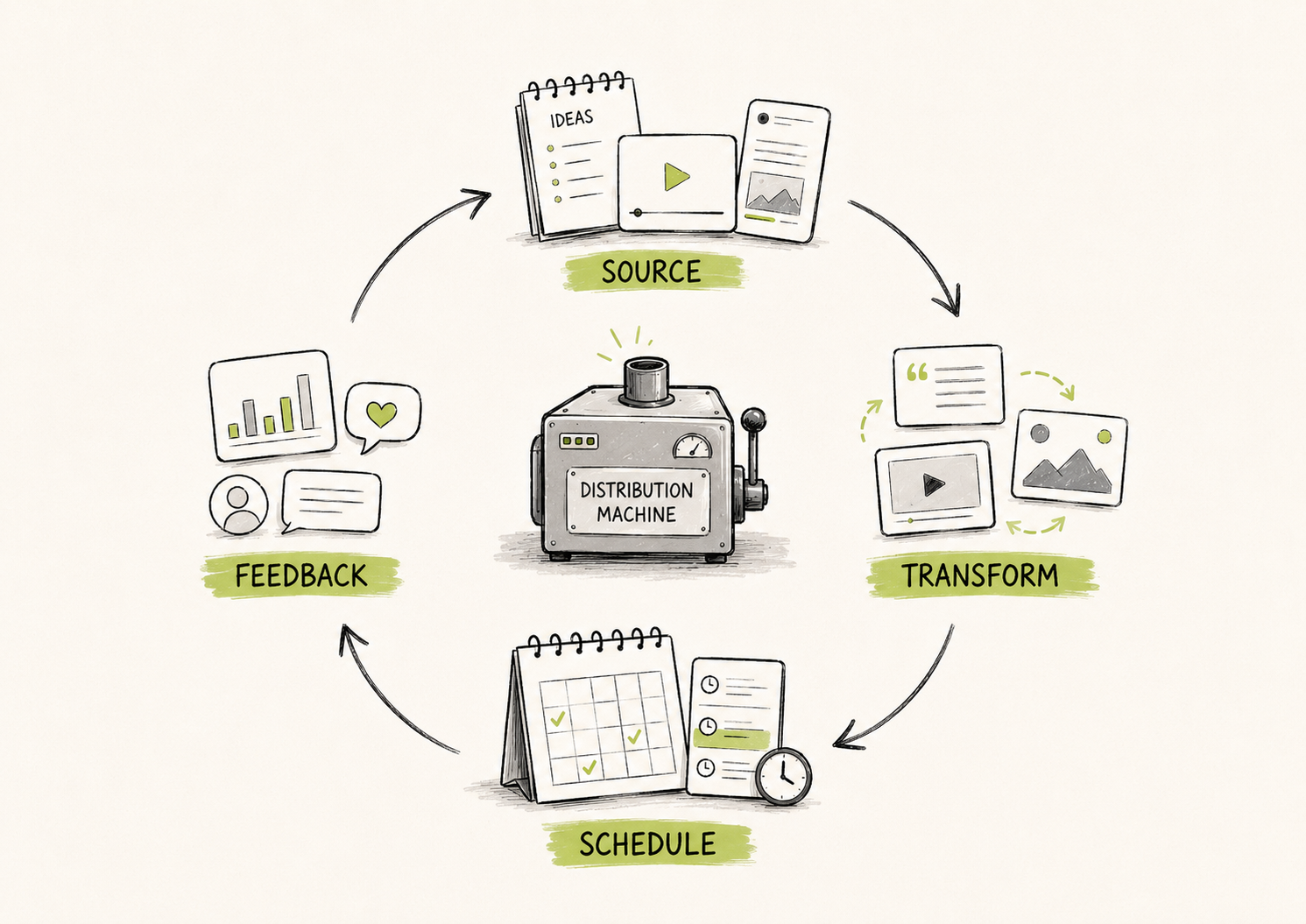
A distribution machine has four parts#
A real content system does not start with “what should we post today?”
It starts with a pipeline.
1. Source#
This is the raw material.
It can be founder notes, product demos, customer calls, long videos, blog posts, internal docs, testimonials, screenshots, or support questions.
Your company is already producing content every day.
You just may not be capturing it.
2. Transform#
This is where one input becomes many outputs.
A demo becomes a Reel.
A lesson becomes a carousel.
A customer objection becomes a founder post.
A product update becomes a short video script.
A strong opinion becomes five caption variations.
This is where AI is useful.
Not because it magically knows your brand.
Because it can generate structured variations faster than a human can manually rewrite the same idea ten times.
3. Schedule#
A content idea is not finished when the copy is written.
It is finished when it is scheduled, published, and visible on the right platform.
If your system stops at “draft created,” you still have a manual bottleneck.
Scheduling is what turns content from a creative task into an operational process.
4. Feedback#
The system needs to learn.
Which hooks get watched?
Which captions get skipped?
Which formats get saved?
Which assets keep underperforming?
Which topics create replies?
Which platforms reward which angle?
Without feedback, you are just posting into the void.
With feedback, the machine gets sharper every week.
“Just post more” is bad advice#
“Post more” is not wrong.
It is just incomplete.
Post more with what system?
If every post requires a fresh idea, fresh design, fresh caption, fresh export, and fresh upload, then “post more” just means “work more.”
That is not a strategy.
That is a burnout plan.
The better question is:
What would need to be true for us to publish every day without thinking about publishing every day?
That question changes the whole workflow.
Now you are not asking for more discipline.
You are asking for infrastructure.
You need:
- a repeatable source of raw material
- reusable formats
- AI-assisted generation
- automated rendering
- scheduling
- performance feedback
- a review flow that does not slow everything down
That is when social media stops feeling like random posting and starts feeling like a system.
The advantage is consistency without collapse#
Volume gets attention.
Consistency is the real advantage.
Anyone can post a lot for three days.
Very few teams can keep publishing for six months without the process falling apart.
That is where distribution machines win.
They reduce the cost of staying visible.
They make it easier to test more hooks, more formats, more platforms, and more angles without rebuilding the workflow every time.
Over time, the machine creates compounding advantages.
You learn which ideas travel.
You learn which assets work.
You learn what your audience ignores.
You learn what your audience repeats back to you.
You build a library of reusable patterns.
The first month may look messy.
The third month starts producing signals.
The sixth month becomes a real distribution asset.
Most teams never get there because their manual process breaks too early.
The takeaway#
You probably don’t need more content ideas.
You need a better way to move ideas through the system.
From raw thought to post.
From post to platform.
From platform to feedback.
From feedback back into the next batch.
That is the real shift.
The next wave of social media teams will not win because they have the biggest content team.
They will win because they build the best distribution machines.
Small teams will look bigger than they are.
Founders will turn one opinion into ten assets.
Marketers will stop rebuilding every post from scratch.
Content calendars will become pipelines, not spreadsheets.
The question is no longer:
What should we post today?
The better question is:
What raw material are we already sitting on that should be working for us?